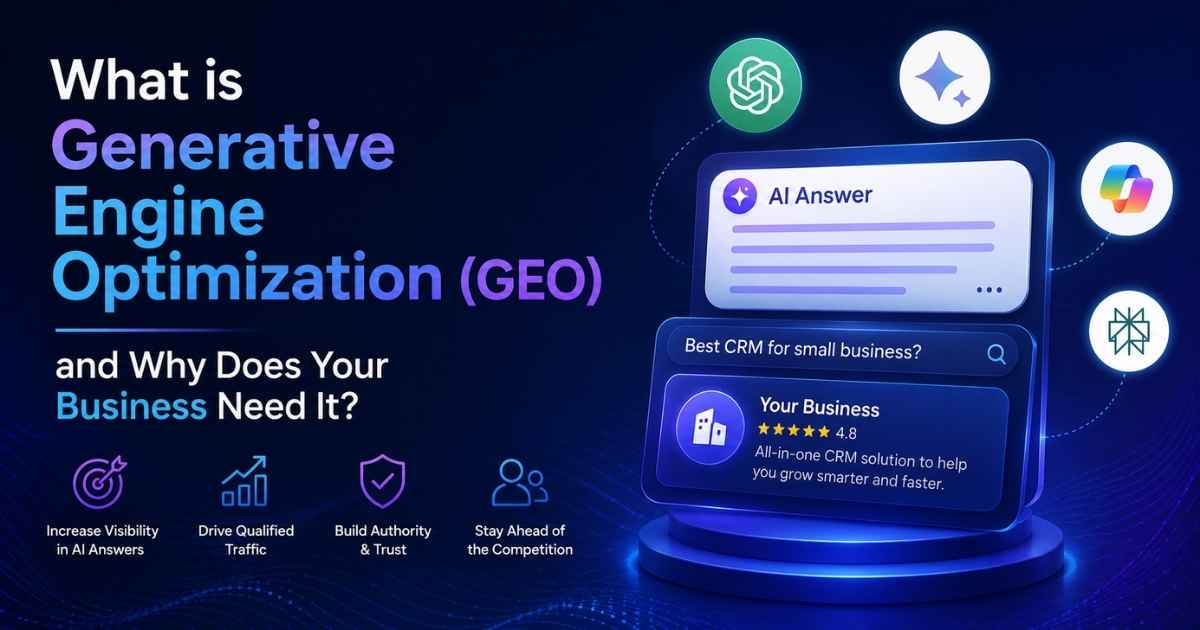
What is Generative Engine Optimization (GEO) and Why Does Your Business Need It?
The way your customers search for information is fundamentally changing.
For two decades, the formula was simple: type a few keywords into Google, scroll past the ads, and click on the blue links. Today, users are asking complex, conversational questions to AI engines like ChatGPT, Perplexity, Claude, and Google’s own AI Overviews (SGE)—and they expect instant, synthesized answers.
If your digital marketing strategy relies solely on traditional SEO, you are already falling behind. Welcome to the era of Generative Engine Optimization (GEO).
In this guide, we will break down exactly what GEO is, how it differs from traditional SEO, and how you can future-proof your brand’s digital authority.
What is Generative Engine Optimization (GEO)?
Generative Engine Optimization (GEO) is the process of optimizing your website’s content, technical structure, and digital footprint so that Artificial Intelligence (AI) models cite your brand as the definitive, authoritative answer to user queries.
Unlike traditional search engines that act as librarians (pointing users to a list of books), AI search engines act as researchers. They read the books, synthesize the information, and generate a direct answer.
GEO ensures that your data, your brand, and your expertise are the primary sources these AI models use to generate those answers.
Traditional SEO vs. GEO: What’s the Difference?
While traditional SEO and GEO share the same ultimate goal—driving targeted traffic to your business—their methodologies are different.
- The Goal: SEO aims to rank a specific URL on page one. GEO aims to have your brand cited as the source in an AI-generated response.
- The Keywords: SEO focuses on short, high-volume keywords (e.g., “best CRM software”). GEO focuses on conversational, long-tail queries (e.g., “What is the best CRM software for a mid-sized marketing agency in India?”).
- The Content: SEO often relies on keyword density and word count. GEO relies on semantic richness, unique data, and direct, factual answers.
- The Metrics: SEO measures clicks and impressions. GEO measures brand mentions, citations, and inclusion in AI knowledge graphs.
Why Your Business Needs GEO Right Now
1. Zero-Click Searches are the New Normal
With Google’s AI Overviews, users often get the answer they need without ever clicking a link. If your brand isn’t mentioned inside that AI-generated box, you are invisible to the user, even if you rank #1 in the traditional organic results below it.
2. High-Intent Buyers Prefer AI
Early data shows that users turning to Perplexity and ChatGPT for product recommendations are further down the sales funnel. They aren’t just browsing; they are asking the AI to help them make a final purchasing decision. Being recommended by an AI carries a massive amount of trust.
3. The First-Mover Advantage
Most of your competitors are still obsessing over keyword density and outdated link-building tactics. By adopting a GEO strategy today, you establish your brand in the AI’s training data and knowledge graphs before your competitors even realize what is happening.
The 4 Pillars of a Winning GEO Strategy
How do you actually optimize for an AI? At Digitalised, we focus on four core pillars:
1. Entity Optimization & Knowledge Graphs
AI models don’t understand “keywords”; they understand “entities” (people, places, concepts, and things) and how they relate to each other. You must clearly define your business entity using advanced Schema Markup (JSON-LD) so the AI knows exactly who you are, what you sell, and where you operate.
2. E-E-A-T (Experience, Expertise, Authoritativeness, Trustworthiness)
AI models are trained to prioritize highly trusted sources to avoid “hallucinations” (giving wrong answers). You must prove your expertise through original research, case studies, author bios, and foundational citations on high-trust directories like Clutch and Crunchbase.
3. Conversational Content Formatting
AI engines love content that is easy to parse. Use clear headings, bullet points, and Q&A formats. Answer the user’s question directly and concisely in the first paragraph, then expand on the details below.
4. Flawless Technical Foundation
An AI crawler will not waste its computational resources trying to parse a slow, broken website. Lightning-fast Core Web Vitals, clean code, and a logical site architecture are non-negotiable prerequisites for GEO.
Ready to Dominate AI Search?
The shift from traditional search to generative AI is the biggest disruption the digital marketing industry has seen in twenty years. You can either adapt and capture this new wave of high-intent traffic, or watch your traditional organic traffic slowly decline.
At Digitalised, we specialize in building data-driven, high-speed digital foundations that dominate both Google and AI search engines.
Want to see how AI engines currently view your website? Click here to request a Free AI Visibility & Technical SEO Audit from our team today.